
What Type of Hydraulic Cylinder Is Best for a Trailer?
Choosing the best Hydraulic Cylinder For Trailer depends on more than lifting capacity alone. Trailer design, load distribution, stroke length, mounting space, and operating conditions all matter. A cylinder that performs well on a dump trailer may be unsuitable for a tilt trailer or a heavy-duty recovery unit. The right choice must match the trailer’s real working environment.
In practical service, telescopic cylinders are common for dump trailers because they provide long extension with limited storage space. Single-acting cylinders can offer simpler installation, while double-acting models provide controlled movement in both directions. However, simplicity is not always better. A basic cylinder may struggle with side loads, uneven ground, or repeated high-pressure cycles. That detail is easy to overlook.
Small details matter. Check the bore diameter, rod strength, retracted length, hydraulic pressure rating, and pin alignment. Even a few millimeters of misalignment can create uneven wear, seal damage, or unstable lifting. The trailer frame must also support the cylinder force without bending or cracking. It is not only about the cylinder.
Reliable selection requires technical specifications from a reputable manufacturer, realistic load calculations, and inspection experience from similar trailers. Weather, road vibration, corrosion, and maintenance habits can change performance over time. In my experience, choosing the largest cylinder is rarely the smartest answer. It may increase weight, cost, and stress on the frame.
This guide examines common hydraulic cylinder types, their strengths, limitations, and suitable trailer applications. It also considers safety, maintenance, and installation concerns. There may be no universal “best” cylinder. The best option is the one that lifts predictably, fits correctly, and remains dependable through demanding daily use.
Trailer Hydraulic Cylinders: Purpose, Movement, and Load Requirements
What Type of Hydraulic Cylinder Is Best for a Trailer?
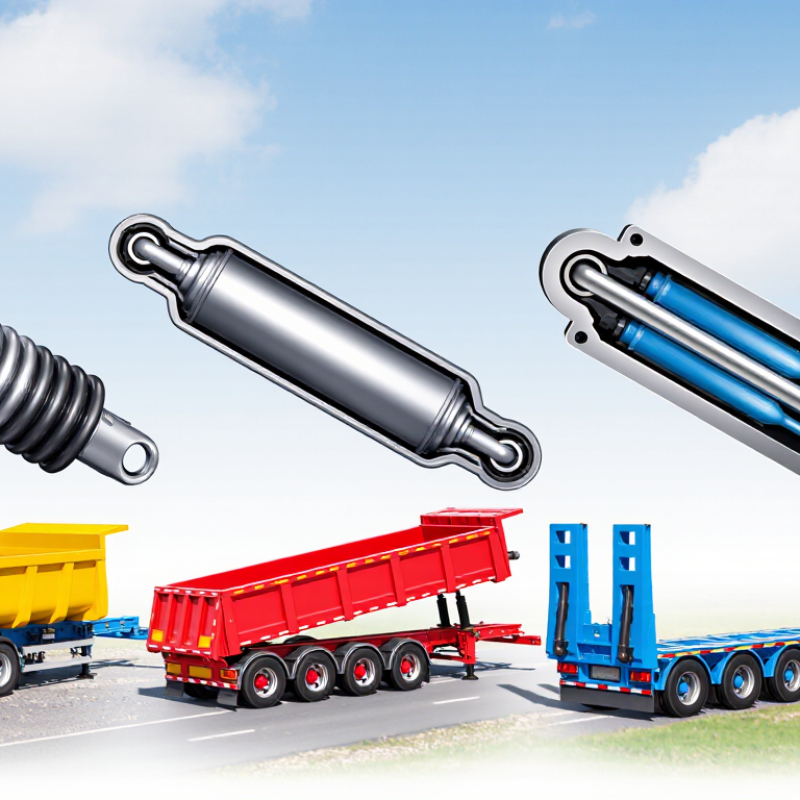
A trailer hydraulic cylinder converts fluid pressure into controlled movement. On a dump trailer, it raises the bed steadily for unloading. A flatbed trailer may need a shorter cylinder for ramps or sliding equipment. The best cylinder depends on movement, available space, and load direction.
Telescopic cylinders suit dump bodies because they provide long extension from a compact retracted length. Single-acting designs can lift efficiently when gravity lowers the bed. Double-acting cylinders offer powered movement in both directions. They may help when the trailer operates on uneven ground. Bore size controls pushing force, while stroke length determines the lifting range. Pressure ratings must match the hydraulic system.
Load placement matters as much as cylinder size. A heavy load near the front creates greater lifting resistance. Off-center cargo can produce side forces that damage the rod and seals. Strong mounting pins, aligned brackets, and a suitable safety margin reduce these risks. Small details matter.
Field technicians often inspect rod scoring, loose pins, and oil leaks before changing a cylinder. Mud and road salt can shorten seal life quickly. The calculation is rarely perfect. Real loading habits may differ from design assumptions. A practical choice should allow for uneven cargo, cold weather, repeated cycles, and limited maintenance. Oversizing is not always better; it can increase stress on the frame and hydraulic pump.
| Trailer Application | Typical Cylinder Type | Primary Movement | Common Stroke Range | Typical Operating Pressure | Typical Load Requirement | Key Advantages | Important Selection Considerations |
|---|---|---|---|---|---|---|---|
| Dump trailer with rear tipping | Telescopic multi-stage cylinder | Long extension with a compact retracted length | Approximately 1,200–2,500 mm | Typically 150–250 bar | High lifting force at the beginning of the dump cycle; capacity depends on body geometry and load distribution | Provides long travel while fitting beneath or inside a relatively short trailer frame | Confirm tipping angle, retracted length, mounting position, pin alignment, hydraulic flow, and stability at full extension |
| Small utility dump trailer | Single-stage welded or tie-rod cylinder | Direct linear lifting of a light dump body | Approximately 300–900 mm | Typically 100–210 bar | Moderate lifting force for landscaping materials, soil, tools, or light construction debris | Simple construction, easy installation, and lower cost than a multi-stage design | Allow clearance for the rod, protect the cylinder from impact, and use a safety prop during maintenance |
| Heavy-duty dump trailer | Heavy-duty telescopic cylinder or paired lift cylinders | High-force extension through a large tipping arc | Approximately 1,500–3,000 mm | Typically 180–250 bar | High force for aggregate, demolition material, wet soil, or other dense loads | Supports demanding duty cycles when correctly sized for force, buckling resistance, and heat control | Check frame strength, cylinder side loading, oil temperature, flow rate, relief-valve setting, and load-center position |
| Front-mounted hoist trailer | Single-stage or double-acting cylinder | Tilting the trailer bed from the front | Approximately 500–1,500 mm | Typically 140–210 bar | Moderate to high force, depending on the hinge location and distance from the load center | Can deliver controlled lifting and lowering with a comparatively straightforward layout | Calculate force at the worst-case angle; the required force is usually highest when the bed is near its starting position |
| Side-tipping trailer | Single-stage double-acting cylinder | Lateral extension and retraction for side discharge | Approximately 600–1,800 mm | Typically 140–210 bar | Moderate to high force with increased sensitivity to uneven loading | Enables controlled side discharge and positive retraction | Use robust pivot mounts, verify side-load limits, and prevent operation on unstable or sloped ground |
| Trailer ramp deployment | Double-acting tie-rod or welded cylinder | Controlled lowering and lifting of a loading ramp | Approximately 300–1,000 mm | Typically 100–210 bar | Low to moderate force, increased by ramp weight and the position of the pivot | Provides positive control in both directions and helps prevent uncontrolled ramp movement | Use flow-control valves where necessary and include mechanical locking or support devices for transport |
| Sliding or ejector-floor trailer | Long-stroke double-acting cylinder | Horizontal pushing and pulling | Approximately 1,000–3,000 mm | Typically 150–250 bar | High thrust, especially when material is compacted or friction is high | Provides controlled material discharge without tipping the trailer body | Size the cylinder for peak breakout force, guide alignment, rod buckling resistance, and continuous-duty heat generation |
| Trailer landing gear or stabilizer | Compact single-stage cylinder or hydraulic motor-driven actuator | Vertical extension and retraction for support | Approximately 200–700 mm | Typically 100–210 bar | Support force rather than payload lifting force; both static and dynamic loads must be considered | Reduces manual effort and can improve positioning accuracy | Never rely on hydraulic pressure alone for long-term support; use mechanical locks or blocking where required |
| High-cycle commercial trailer equipment | Welded double-acting cylinder with hardened rod | Repeated extension and retraction | Approximately 300–1,500 mm | Typically 140–250 bar | Varies with attachment geometry and duty cycle; fatigue resistance is critical | Suitable for frequent operation when seals, rod finish, mounting, and lubrication are properly maintained | Consider cycle frequency, rod coating, seal compatibility, filtration, oil cleanliness, and service access |
| Corrosive or wet operating environment | Protective-coated welded cylinder or stainless-steel-compatible design | Depends on the trailer function | Application-dependent | Application-dependent, commonly 100–250 bar | Determined by the trailer mechanism and environmental loading | Improves resistance to moisture, salt, mud, and outdoor exposure | Specify suitable rod protection, wiper seals, coatings, drain paths, corrosion-resistant fasteners, and regular inspection |
| Design Item | Practical Guidance | Why It Matters |
|---|---|---|
| Bore diameter | Calculate required force using hydraulic pressure and piston area: Force = Pressure × Area. | A larger bore produces more force at the same pressure but may increase weight, oil volume, and cost. |
| Rod diameter | Select the rod for tensile and compressive loads, with additional attention to long-stroke buckling. | An undersized rod can bend under compression or side loading, especially when the cylinder is extended. |
| Stroke length | Measure the required pin-to-pin movement and include the complete trailer operating arc. | Insufficient stroke prevents full movement; excessive stroke can cause overextension or structural interference. |
| Mounting arrangement | Use aligned pins, spherical bearings, or suitable clevis mounts to accommodate angular movement. | Misalignment creates side loading, which accelerates seal, rod, bearing, and tube wear. |
| Operating pressure | Keep the working pressure within the cylinder, pump, hose, valve, and relief-valve ratings. | The cylinder is only as reliable as the weakest component in the hydraulic circuit. |
| Load distribution | Calculate the worst-case load position, not only the average payload. | A load placed far from the hinge can require substantially more cylinder force than a centered load. |
| Safety factor | Apply an appropriate engineering margin for shock loads, uneven loading, fatigue, and operating uncertainty. | Real trailer loads can be dynamic and uneven; the rated payload alone does not define cylinder size. |
| Maintenance and safety | Inspect rods, seals, pins, hoses, mounts, and leaks regularly; support raised bodies mechanically before service. | Hydraulic pressure can be lost without warning, creating a serious crush hazard. |
Related Posts
-
2026 Top Hydraulic Cylinder For Trailer Types Guide
-
How to Choose the Best Hydraulic Cylinder for Trailer Use?
-
10 Essential Tips for Choosing Hydraulic Cylinder For Forklift?
-
Top 10 Hydraulic Cylinders for Trailers You Should Buy?
-
Top 10 Hydraulic Oil Cylinder Tips for Buyers in 2026?
-
2026 Best Hydraulic Oil Cylinder Manufacturers Worldwide